|
Recording
Uttlesford History
Milestones
& Cast
iron guideposts in the Uttlesford District
|
|
We
are very grateful to John Nicholls for his permission to link to his
two sites and to reproduce his introduction.
Click on either image below to access the site
The Milestones and Way
Markers of Essex
When
this website was first being put together (summer 2002), a survey of
Essex milestones is still underway. By October one hundred
and sixteen (116) milestones and mileposts were identified as remaining
in the county and less than half have Grade II listed status.
It was believed that this would be the final total but almost
a year later new examples continue still come to light. Over
one hundred and thirty (130) have now been located. As items that had
virtually outlived their reason for existence by the opening of the
20th century, it is amazing that so many do survive. The
demise of the turnpikes in the mid 1800s (The Hadleigh Trust folded as
early as 1820) meant that many stones were abandoned and sometimes
robbed out for use elsewhere. Road improvements in the 1920s
and 1930s probably caused the further loss of many stones.
Further losses can be blamed on the Second World War when, in 1940 with
the possibility of an invasion, all milestones, mile plates and guide
posts were removed, buried or defaced. Many were never
replaced once the invasion threat had passed. Since the
Second World War further losses have occurred, partly through further
road redevelopments. The humble milestone is easy prey for
the giant machinery used in road building. Unfortunately mile
plates (cast iron milestones also known as mileposts) are sometimes
targeted by thieves.
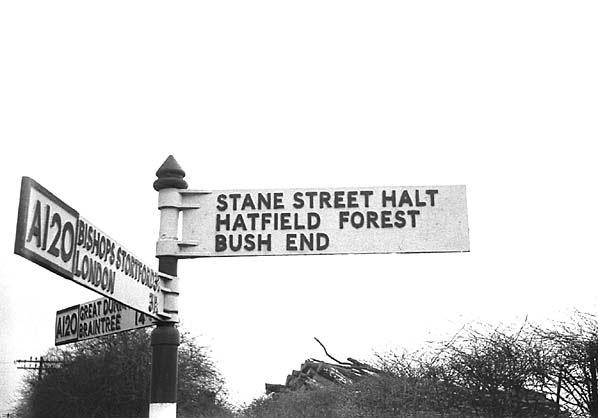
Unlike milestones, the
guidepost, also referred to as signpost, finger post or direction post,
still has an everyday purpose, especially in rural areas. Old
wooden examples still to be seen into the 1950s have long since
disappeared; in fact many were probably not re-erected in
1944. Post war, they were usually replaced by new wooden
signs or precursors of the modern reflective types so common throughout
the United Kingdom today. 19th century cast iron posts with
fingered arms were still fairly common into the 1920s but now probably
destroyed except one preserved in the Upminster Tithe Barn Museum.
A survey is currently being made to ascertain the number of old iron
guide posts extant in
Essex. 'Old' means those erected prior to c.1939 and mainly
comprise cast iron examples ordered by Essex County Council or their
agents in the 1920s and 1930s. The majority of the 1920s and
1930s posts were manufactured by the Maldon Iron Works of Fullbridge,
Maldon, Essex. Although still fulfilling their role in
guiding the motorist and walker alike, their future is not guaranteed
and many suffer from neglect as well as destruction on the grounds of
being in "an unsafe condition". From the same period,
although not as yet reliably dated, are others by Stanton Ironworks,
Derbyshire. The Stanton types are generally recognisable by
their narrow ring (annulus) finial castings on the post and rounded
ends to the arms.
More details of the posts
manufactured by Maldon Iron Works for Essex County Council have
recently become available. The ledgers, daybooks, order
books, etc., of the company from 1873 to 1954 have been catalogued by
the Essex Record Office. They may be found under record D/F
11 (with about 50 sub-divisions). The cost of Maldon Iron
Works posts with arms varied between £4/15/-
(£4.75p) to £6/10/- (£6.50p) in the
1920s. 7 inch arms were 12/6 (62½p) and
10½ inch arm 15/- (75p). An extra 5/- (25p) was
incurred for a single stagger (one arm above the other) or 10/- (50p)
for a double stagger. This was to cover the cost of extra
collars between the arms.
Uttlesford in the
northwest of Essex has by far the greatest number of surviving cast
iron guideposts; over one third of those in the county are to be found
in this district. As to be expected, most are Maldon Iron
Works examples but there is a good selection of Stantons too.The
condition of the posts varies enormously but those at Felsted (one by
Maldon Iron Works and the other two by Stanton) have been maintained to
a very high standard. Some refurbishment (mostly painting)
has been carried out to many other posts in the district during
2003. Unfortunately, with the exception of the Felsted
examples and the one at High Roding, the traditional black and white
banding has not been applied to the posts.
The
three cast iron fingerposts in Henham were all part of an
order by Essex
County Council
(order number 2404) dated 6 February 1933 and were made by the Maldon
Iron Works
of Maldon,
Essex. Two
still retain their semicircular parish plate finials (it would be nice
if someone would fund a replacement for the missing one). The
semicircular finials are unique to Essex and follow similar shaped
finials fitted to wooden fingerposts in the late 1800s. Some
of the wooden examples certainly survived until 1940 but I have no
evidence of any wooden ones refitted after the war.
Uttlesford
is well-endowed with cast iron
fingerposts; more than any other local authority in Essex.
Most are being maintained in a 'reasonable' condition although I am
disappointed that during repainting over recent years there has been a
move to leaving the pillars plain white rather than the 1933 black and
white banded livery. The High Roding post was one of the more
recent examples to lose its banding.
All
of the surviving iron posts in Uttlesford
District date from the 1920s and 1930s and most follow the recommended
design features of the Ministry of Transport 1920/21.
It
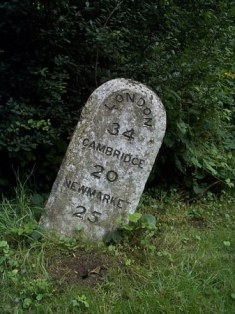
should also be noted that Uttlesford has an
almost complete sequence of milestones alongside the former
A11. Just one missing between Birchanger and Great
Chesterford. And mention also of a probable county boundary
stone at Great Chesterford that seems to have gone by the
way. Half the village used to be in Cambs and where the
boundary crossed the former A11 a stone still stands. Earlier
this year I dug out a milestone on the Walden/Stump Cross (B184) road
after being contacted by Elaine Culling, the Gt Chesterford Parish
Clerk.
List of surviving
cast iron
posts in Uttlesford District
|
abbreviations
|
| MIW = Maldon Iron Works. |
STN = Stanton |
| Wed = Wedlake |
U/k = Unknown |
|
|
|
Arms. First figure
denotes arms extant. [Original number of arms in brackets]
|
| code |
location |
grid ref. |
arms |
finial |
maker |
notes |
| UT01 |
ARKESDEN
|
TL
4844 3430 |
3 |
Conical |
MIW |
Short
post. Good condition |
| UT02 |
AYTHORPE RODING |
TL
tbc
|
|
Semicircle |
MIW |
finial reused on wooden post
|
| UT03 |
BENTFIELD END |
TL
5052 2546 |
3 |
Ornate |
STN? |
Wooden
arms renewed 2004 |
| UT04 |
BIRCHANGER |
TL
5081 2451 |
0 |
Semicircle |
MIW |
Poor
condition
|
| UT05 |
BIRCHANGER |
TL
5071 2431 |
1 |
Semicircle |
MIW |
Ordered
1/7/1927. Now with wooden arm |
| UT06 |
BROXTED |
TL
5770 2703 |
3
|
|
MIW |
|
| UT07 |
BROXTED |
TL
5856 2866 |
3 |
Semicircle |
MIW |
Suckstead
Green. Short post |
| UT08 |
CATMERE END |
TL
4897 3948 |
|
Conical |
MIW
|
|
| UT09 |
CHRISHALL |
TL
4460 3832
|
|
Conical |
MIW |
|
| UT10 |
CHRISHALL |
TL
4490 3833
|
|
Halo |
STN |
White
Bridge |
| UT11 |
CHRISHALL |
TL
4453 3940
|
|
Halo |
STN |
|
| UT12 |
ELMDON |
TL
4613 3962 |
|
Semicircle |
MIW
|
|
| UT13 |
FELSTED |
TL
7119 2050 |
|
Halo |
STN |
Mole
Hill Green
|
| UT14 |
FELSTED |
TL
7206 1978
|
|
Semicircle |
MIW |
Willows
Green |
| UT15 |
FELSTED |
TL
6749 2030 |
3 |
See
note |
STN |
Unusual
finial may be recent replacement |
| UT16 |
GREAT DUNMOW |
TL
8298 2161 |
2
[4] |
Conical |
MIW |
|
| UT17 |
HATFIELD BROAD OAK |
TL
5575 1585 |
3 |
Semicircle |
MIW |
|
| UT18 |
HATFIELD BROAD OAK |
TL
5325 1793 |
3 |
Halo |
STN |
|
| UT19 |
HENHAM |
TL
5617 2743 |
3 |
Semicircle |
MIW |
Part
of Order No. 2404 dated 6 February 1933 |
| UT20 |
HENHAM |
TL
5343 2882 |
3 |
Semicircle |
MIW |
Part
of Order No. 2404 dated 6 February 1933 |
| UT21 |
HENHAM |
TL
5462 2851 |
3 |
Missing
(semi
circular) |
MIW |
In
village. Part of Order No. 2404 dated 6 February 1933 |
| UT22 |
HIGH EASTER |
TL
6180 1583 |
3 |
Semicircle |
MIW |
|
| UT23 |
HIGH EASTER |
TL
tbc |
3 |
Semicircle |
MIW |
|
| UT24 |
HIGH RODING |
TL
605 177 |
4 |
Semicircle |
MIW |
|
| UT25 |
LANGLEY |
TL
4380 3442 |
3 |
Conical |
MIW |
All
arms are 10 1/2 inch type |
| UT26 |
LANGLEY |
TL
4460 3511 |
|
Conical |
MIW |
Langley
Upper Green
|
| UT27 |
LANGLEY |
TL
437 344 |
|
Conical |
MIW |
Langley
Lower Green
|
| UT28 |
LINDSELL |
TL
6435 2698 |
3 |
Semicircle |
MIW |
|
| UT29 |
MANUDEN |
TM
4915 2671 |
3 |
Missing |
MIW |
|
| UT30 |
MANUDEN |
TL
4921 2600 |
3 |
Conical |
MIW? |
Non-tapered
post |
| UT31 |
MOTTS GREEN |
TL
6129 1262 |
3
|
|
MIW
|
|
| UT32 |
RICKLING GREEN |
TL
5096 2978 |
1 |
Missing |
MIW |
Short
post |
| UT33 |
RICKLING GREEN |
TL
5095 2990 |
2
[3] |
Missing |
MIW |
|
| UT34 |
SAFFRON WALDEN |
TL
5314 3786 |
1
[3] |
Broken |
STN |
|
| UT35 |
SAFFRON WALDEN |
TL
5430 3866 |
[2]
? |
Cone |
U/k |
Straight
post in poor condition. Perhaps not pre-1940 |
| UT36 |
STEBBING |
TL
6540 2529 |
3 |
Semicircle |
MIW |
Bran
End |
| UT37 |
STEBBING |
TL
6790 2367 |
3 |
Broken |
MIW |
Finial
was a semicircular |
| UT38 |
TILTY |
TL
5994 2757 |
3 |
Conical
|
|
|
| UT39 |
WENDENS AMBO |
TL
4965 3611 |
2
[3] |
Conical |
MIW |
|
| UT40 |
WENDENS AMBO |
TL
4963 3611 |
3 |
Conical |
MIW |
Clanverend
Bridge. 3rd arm is replacement |
| UT41 |
WENDENS LOFTS |
TL
4698 3800 |
|
Halo |
STN
|
|
| UT42 |
WENDENS LOFTS |
TL
4601 3788 |
|
Halo |
STN |
|
| UT43 |
WHITE RODING |
TL
575 134 |
3 |
Cap |
MIW |
|
| UT44 |
HIGH EASTER |
TL 6474
1575 |
3 |
Semicircle |
MIW |
|
| UT45 |
HATFIELD HEATH |
TL
5268 1420 |
3 |
Semicircle |
MIW |
|